
For the second year in a row, I tried to teach my newly minted second graders at The Elementary School to refer to me as "Ms. Annalog" instead of "Annalog Teacher." I know that the title of "Teacher" in Korean holds much respect, but the use of this honorific in English is a great detractor from one's level of English, no matter how advanced the speaker might be. Even if you have the pronunciation, vocabulary, and grammatical skillz of a "native English speaker" the mere fact that you referred to your English instructor as "So-and-So Teacher" is a telltale sign that you learned English as a second/foreign language. Plus, for some strange reason, when someone addresses me as "Teacher" or "Annalog Teacher" I can't help picturing Ralph Wiggins.
My class of second graders last year were particularly bright, and quick to practice speaking in English. I thought, surely they'd have no trouble referring to me as "Ms. Annalog." When I began writing the words "miss" and "mister" on the board, the class was quick to identify the terms. They even laughed appropriately at my joke about being called "Mr. Annalog."
"Who am I?" I'd ask.
"Ms. Annalog," they'd say obligingly.
I patted myself on the back, beaming with self-importance.
The next day, the most fluent student in the class asks, "Annalog Teacher, what are we doing today?"
Annalog Teacher fail.
The students proceeded to call me "Annalog Teacher" for the rest of the year. Some of the more cheeky first grade students even referred to me simply as "Annalog", like I'm their chingu or something!
That is why when we started the new school year last week, I was determined to set my new batch of second graders straight. I gave the same spiel about how to address teachers in English. The kids nodded their heads in comprehension. They repeated after me when I said, "Miss Annalog." With all that said and done, I had little expectation that they would stop referring to me as "Teacher Annalog."
But on Friday... at the end of class, one of my students says in parting, "Goodbye Annalog Teacher Miss."
Miss! She said, "Miss!"
She totally made my day.
As one of my colleagues pointed out, it is unlikely that the students will refer to us as Ms. So-and-So because the homeroom teachers refer to us as So-and-So Teacher. Despite what has now become a yearly attempt at teaching my students how to address a teacher in English or the fact that I've written a whole blog post about wanting to be referred to as "Miss Annalog", I'm not all that bothered if a student calls me Annalog Teacher. Go ahead and roll your eyes, but the "teacher" part has become an intrinsic part of who I am.
05 March 2011


28 February 2011
"Trick of the Eye" Trompeloeil Museum
Cyndi and I met up with Heng this weekend and she took us to the "Trick Eye" Trompeloeil Museum in Hongdae (nearish Exit 9). It was a shame that I was dressed like a granny and hadn't brushed my hair because we took tons of photos! The Tromepleil Museum features paintings using trompe l'oeil, a technique in which 2D art is made to look 3D.
Optical illusions + Photo Op = a yupgi girl's dream come true.
If you ever wondered what sort of underwear the screaming creature is wearing in Edward Munch's painting or wanted to ddong chim a cherubic masterpiece, then this is the place for you.


They even have a couple of those holographic paintings featuring a woman in various states of dress. Look at it from one angle and she's dressed in 18th century garb. Step a few centimeters to the left, and she's in her knickers. Step a little more, oh, look at it that. She's nekkid.
This place is a safe zone for silliness and juvenility.
The Trompeloeil museum is located in the 서교프라자 (basement, second floor). It's part of "Santorini Seoul" which as far as I could tell, is a hodgepodge of various "art" exhibits including the cat art gallery, a large "Where's Willy (Waldo)?" poster, and an exhibit featuring ugly dresses covered in ribbons (or something like that. I didn't really get the "concept"). Your 10,000 won admissions fee to the Trompeloeil Museum gains you access to all of the featured exhibits in "Santorini Seoul." As you can probably guess by the name, "Santorini Seoul" is meant to look like Santorini, Greece, which means there are lots of blue doors and blue skies. Are you in Hongdae or on the set of Mama Mia? No one will be able to tell.

Admissions is 10,000 won. Tickets are 8,000 won if you come in a group of 20 or more, but please don't come in a group of 20. The place is not big enough. 20 people will only mean that you'll always get a wayward elbow in your photo.
Hold onto your tickets, because admissions is 2,000 won less for each successive return. E.g., 2nd re-entry = 8,000 won, 3rd re-entry = 6,000 won, and so forth.
Hours of Operation: 10 Am to 10 PM (must buy your tickets by 9 PM)
Phone: 02.3144.6300
For for more information about the museum, check out their website
http://www.trickeye.co.kr/
There's also a Trompeloeil Museum in Jejudo. They're aiming to expand the Jeju location to a massive Santoriniesque complex, at least that's what they've envisioned in their playdough model (you can see this model at the Hongdae location).
Side note: I think it's fascinating how Korean museum owners are weirdly focused on seemingly unrelated interests. The Trompeloeil people for example are into optical illusions, Santorini, and colorful paintings of cats. You got the butterfly museums in Jeju and Paju City featuring some rich guy's obsession with making "art" out of dead, expensive butterflies. You can't forget the Teddy Bear Museum and their creepy re-enactments of random moments in history/pop culture. Don't even get me started on the Jeju Sex Museum (which if you're curious is a cross between a College Campus Health Center and an otaku's hoard of Japanese hentai and figurines.)
Moving on... time for some photos! Keep in mind: Heng, Cyndi, and I are 3D. Everything else is 2D!


헹언니, 고마워요!
Optical illusions + Photo Op = a yupgi girl's dream come true.
If you ever wondered what sort of underwear the screaming creature is wearing in Edward Munch's painting or wanted to ddong chim a cherubic masterpiece, then this is the place for you.


They even have a couple of those holographic paintings featuring a woman in various states of dress. Look at it from one angle and she's dressed in 18th century garb. Step a few centimeters to the left, and she's in her knickers. Step a little more, oh, look at it that. She's nekkid.
This place is a safe zone for silliness and juvenility.
The Trompeloeil museum is located in the 서교프라자 (basement, second floor). It's part of "Santorini Seoul" which as far as I could tell, is a hodgepodge of various "art" exhibits including the cat art gallery, a large "Where's Willy (Waldo)?" poster, and an exhibit featuring ugly dresses covered in ribbons (or something like that. I didn't really get the "concept"). Your 10,000 won admissions fee to the Trompeloeil Museum gains you access to all of the featured exhibits in "Santorini Seoul." As you can probably guess by the name, "Santorini Seoul" is meant to look like Santorini, Greece, which means there are lots of blue doors and blue skies. Are you in Hongdae or on the set of Mama Mia? No one will be able to tell.

Admissions is 10,000 won. Tickets are 8,000 won if you come in a group of 20 or more, but please don't come in a group of 20. The place is not big enough. 20 people will only mean that you'll always get a wayward elbow in your photo.
Hold onto your tickets, because admissions is 2,000 won less for each successive return. E.g., 2nd re-entry = 8,000 won, 3rd re-entry = 6,000 won, and so forth.
Hours of Operation: 10 Am to 10 PM (must buy your tickets by 9 PM)
Phone: 02.3144.6300
For for more information about the museum, check out their website
http://www.trickeye.co.kr/
There's also a Trompeloeil Museum in Jejudo. They're aiming to expand the Jeju location to a massive Santoriniesque complex, at least that's what they've envisioned in their playdough model (you can see this model at the Hongdae location).
Side note: I think it's fascinating how Korean museum owners are weirdly focused on seemingly unrelated interests. The Trompeloeil people for example are into optical illusions, Santorini, and colorful paintings of cats. You got the butterfly museums in Jeju and Paju City featuring some rich guy's obsession with making "art" out of dead, expensive butterflies. You can't forget the Teddy Bear Museum and their creepy re-enactments of random moments in history/pop culture. Don't even get me started on the Jeju Sex Museum (which if you're curious is a cross between a College Campus Health Center and an otaku's hoard of Japanese hentai and figurines.)
Moving on... time for some photos! Keep in mind: Heng, Cyndi, and I are 3D. Everything else is 2D!


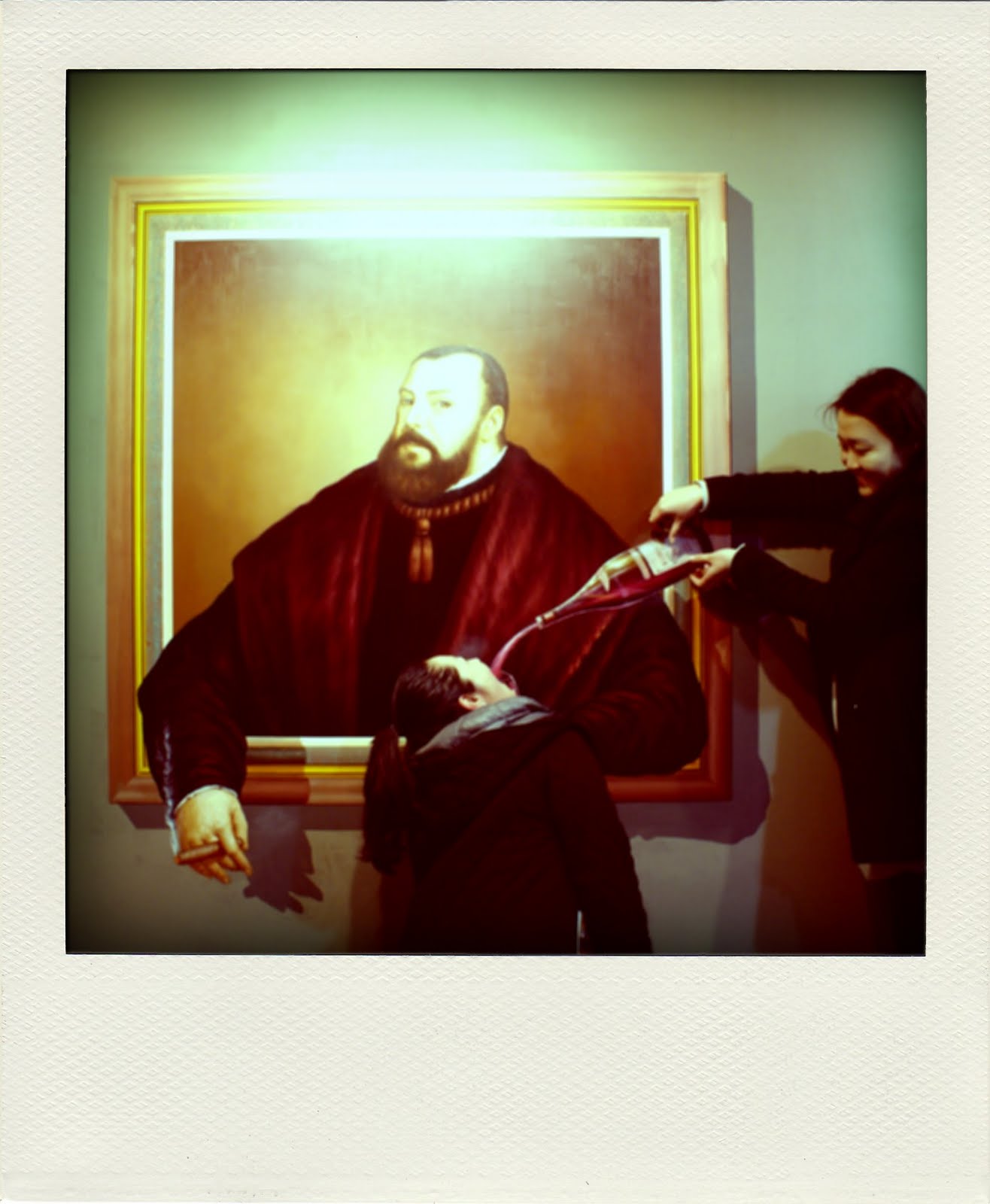


헹언니, 고마워요!
17 November 2010
Last Minute Trip to Hong Kong
I've been meaning to post about so many things for the past...year.
Topics include:
- recent trip to Hong Kong
- the baker's market
- how Seoul was eerily clean and polite thanks to the G20
- Evaluations of late night food trucks in Itaewon
- Halloween
- getting a card for the public library
- Paju Book City
- the freaky butterfly museum that has haunted me for months
- ranting and raving about the bipolar weather
- getting nekkid in a Korean bath house
- the gentrification of Hannam-dong/Itaewon
- the Americanization of eMart
The list goes on...
Real life, however, keeps trumping virtual life. I know. Somebody needs to get her priorities straight. I probably won't get to most of the topics in my list, but I've decided to begin with the topic that boasts the most photos -- a last minute trip to Hong Kong!


Earlier this month, when Cyndi realized that we had a long weekend off from school, she started scouring the web for a cheap last minutes deals to...anywhere out of Seoul. She managed to find a really good deal with Air India to Hong Kong.
In my experience, there are two reasons to visit Hong Kong: (1) high-end, duty free shopping or (2) eating. Since we've both done all the touristy stuff previously, this trip was all about the eats.
AIR INDIA: Is it weird that I love airplane food so much? I almost missed meal time, but the Air India flight attendant made sure I got my chicken meal. I was sound asleep, but the flight attendant persisted until I woke up. Then she brusquely thrusted the chicken meal in my face. I guess she assumed that small, drowsy Asian girls are not into vegetarian curry? The service on Air India may be casual in comparison to the Korean airlines (e.g., The flight attendant told Cyndi to place her coffee cup and tray on the seat next to her. The flight attended couldn't be bothered to put anything away given that the plane was landing), but Air India is still way more comfortable than most American planes.

I am going to warn you. Most of the following photos will feature food or beverage. As I mentioned earlier, we came to Hong Kong to eat.
We had tea everyday!

Hong Kong Street Food, i.e., Deep fried meats and vegetables on sticks. Mmm...

Cyndi must have taken this lady's fish balls.

Won Ton Noodles

Dim Sum
Many thanks to Dean for taking us around!

Cyndi read about this temple in one of those free magazines from the airport. This is the place to do the shaking-stick-fortunetelling-thing.

Step 1: Go to the guy in the tent and pick up a bamboo cup full of numbered sticks.

Step 2: Kneel before the idol. Think of your question. Shake that cup until a stick falls loose onto the floor. The number on the stick corresponds with your fortune.

Step 3: Exit the temple. Veer right towards the fortunetelling arcade. Choose from the several dozens of stalls. Give them the number of your stick, and for a fee, they will interpret the
meaning of your fortune.

Afternoon Tea at the Peninsula Hotel

Checked out the Hong Kong Walk of Fame (I don't think that's what it's called). Jackie Chan was one of the few names I recognized.

One of the most peculiar things we ate in Hong Kong was something called "Affluent Aberdeen Prawns." We stopped for a bite at one of those open markets near Mongkok. The featured dish at this shop was garlic fried "Affluent Aberdeen Prawns."
"Garlic, fried prawns?" we thought. That sounds good. Boy were we suckered!

These prawns are far from affluent. If you go to wikipedia, you'll find that another name for these prawns are "sea locusts" or "prawn killers". They're not shrimp at all. These are the beasts that kill shrimp! We had no idea.

You may as well just eat garlic and salt, because there's hardly any meat in these "affluent prawns." At first we tried eating them as we would with normal shrimp. I broke off the head, then tried to peel off the rest of the shell. It was really annoying, and borderline futile.
It was difficult to pull out any "prawn" meat. We ended up asking a gentleman at the marketplace how to eat the prawns. He was pretty annoyed by my question, but he did show us to to shake and break the prawns. (I'm thinking he made up this technique for stupid foreigners who think that "Aberdeen Affluent Prawns" are actually edible.) Caught the technique on video in case you're curious. Look, Ma. It's shake and break!
By the way, did you know that San Miguel is a Hong Kong beer.

We did a number of things in Hong Kong, but I sort of failed at taking photos this time around.
Topics include:
- recent trip to Hong Kong
- the baker's market
- how Seoul was eerily clean and polite thanks to the G20
- Evaluations of late night food trucks in Itaewon
- Halloween
- getting a card for the public library
- Paju Book City
- the freaky butterfly museum that has haunted me for months
- ranting and raving about the bipolar weather
- getting nekkid in a Korean bath house
- the gentrification of Hannam-dong/Itaewon
- the Americanization of eMart
The list goes on...
Real life, however, keeps trumping virtual life. I know. Somebody needs to get her priorities straight. I probably won't get to most of the topics in my list, but I've decided to begin with the topic that boasts the most photos -- a last minute trip to Hong Kong!


Earlier this month, when Cyndi realized that we had a long weekend off from school, she started scouring the web for a cheap last minutes deals to...anywhere out of Seoul. She managed to find a really good deal with Air India to Hong Kong.
In my experience, there are two reasons to visit Hong Kong: (1) high-end, duty free shopping or (2) eating. Since we've both done all the touristy stuff previously, this trip was all about the eats.
AIR INDIA: Is it weird that I love airplane food so much? I almost missed meal time, but the Air India flight attendant made sure I got my chicken meal. I was sound asleep, but the flight attendant persisted until I woke up. Then she brusquely thrusted the chicken meal in my face. I guess she assumed that small, drowsy Asian girls are not into vegetarian curry? The service on Air India may be casual in comparison to the Korean airlines (e.g., The flight attendant told Cyndi to place her coffee cup and tray on the seat next to her. The flight attended couldn't be bothered to put anything away given that the plane was landing), but Air India is still way more comfortable than most American planes.

I am going to warn you. Most of the following photos will feature food or beverage. As I mentioned earlier, we came to Hong Kong to eat.
We had tea everyday!

Hong Kong Street Food, i.e., Deep fried meats and vegetables on sticks. Mmm...

Cyndi must have taken this lady's fish balls.

Won Ton Noodles

Dim Sum
Many thanks to Dean for taking us around!

Cyndi read about this temple in one of those free magazines from the airport. This is the place to do the shaking-stick-fortunetelling-thing.

Step 1: Go to the guy in the tent and pick up a bamboo cup full of numbered sticks.

Step 2: Kneel before the idol. Think of your question. Shake that cup until a stick falls loose onto the floor. The number on the stick corresponds with your fortune.

Step 3: Exit the temple. Veer right towards the fortunetelling arcade. Choose from the several dozens of stalls. Give them the number of your stick, and for a fee, they will interpret the
meaning of your fortune.

Afternoon Tea at the Peninsula Hotel

Checked out the Hong Kong Walk of Fame (I don't think that's what it's called). Jackie Chan was one of the few names I recognized.

One of the most peculiar things we ate in Hong Kong was something called "Affluent Aberdeen Prawns." We stopped for a bite at one of those open markets near Mongkok. The featured dish at this shop was garlic fried "Affluent Aberdeen Prawns."
"Garlic, fried prawns?" we thought. That sounds good. Boy were we suckered!

These prawns are far from affluent. If you go to wikipedia, you'll find that another name for these prawns are "sea locusts" or "prawn killers". They're not shrimp at all. These are the beasts that kill shrimp! We had no idea.

You may as well just eat garlic and salt, because there's hardly any meat in these "affluent prawns." At first we tried eating them as we would with normal shrimp. I broke off the head, then tried to peel off the rest of the shell. It was really annoying, and borderline futile.
It was difficult to pull out any "prawn" meat. We ended up asking a gentleman at the marketplace how to eat the prawns. He was pretty annoyed by my question, but he did show us to to shake and break the prawns. (I'm thinking he made up this technique for stupid foreigners who think that "Aberdeen Affluent Prawns" are actually edible.) Caught the technique on video in case you're curious. Look, Ma. It's shake and break!
How to Eat "Affluent Aberdeen Prawns" from Annalog on Vimeo.
By the way, did you know that San Miguel is a Hong Kong beer.

We did a number of things in Hong Kong, but I sort of failed at taking photos this time around.
26 October 2010
"Check it Out" the Hangul
My sister just sent me to a link to music video posted on Jonny Ali's blog. If this will.i.ma ft. Nikki Minaj video has anything to say about it, Hangul's burgeoning on global cool. We'll know that Hangul's become a full fledged trend when we see some random Korean phrases tattooed on the beefy arm of some drunken frat boy.
I like the fact that Korean in the mv matches up with the lyrics.
I like the fact that Korean in the mv matches up with the lyrics.
28 September 2010
Taking the GRE in Seoul - UPDATED
I am taking the GRE in October. I was already irritated by the fact that graduate programs even require such hogwash, but the whole registration process has got me resenting the whole ETS institution. I spit on you, ETS!* May you be afflicted with the itch, and have no nails to scratch with.**
I'm ever so grateful that I can take the GRE in Seoul, but can I just ask, how do all those ESL GRE test takers manage to register for the test? I, for one, found the process a bit mind boggling. It hurts my head just thinking about it.
It's very likely that I'm just a big moron, but I'm sure that there are other people out there who have had/will have a difficult time registering for the GRE in South Korea. Thus, I've decided to put together some tips and info. You are very welcome.
First of all, forget registering online. Thanks to bunch of dastardly, cheating fiends, test-takers in China, Hong Kong, and South Korea must take the Split-Test. This I have no problem with because (a) I got to do the Writing Section on the computer (b) I get to complete the Verbal/Qualitative using good ol' paper and pencil (c) I have a nice long break between the Writing and Multiple Choice sections.
"DRIVING DIRECTIONS
1.TAKE OFF -SUBWAY 5 LINE GONGDEOK STATION 2.EXIT 1 3.LOOK FOR NATIONAL HEALTH INSURANCE B/D 4.FULBRIGHT B/D JUST NEXT TO NATIONAL HEALTH INSURANCE B/D."
At first glance, the directions seemed helpful. That is, until I got to number three, "Look for National Health Insurance Building." Firstly, you will not be able to spot the National Health Insurance Building from Gongdeok Station Exit 1. Secondly, even if you could fly or see through buildings, you would not recognize the National Health Insurance Building because its name will be written in Hangul.
There's probably a more efficient route (like this one), but here's how I managed to find the Fulbright Building.
4. Look out for a large building (there will be a guard stand out front) called 국민건강보험 (aka "National Health Insurance). Don't get too excited though. Remember, you are actually looking for the Fulbright Building.
5. Fortunately, the Fulbright Building really is next door, only the building is small, so it's easy to miss. Look out for a small alleyway immediately following the National Health Insurance Building.
Head up to the 2nd Floor of the building. Look at the posting on the bulletin board for instructions (in English) on how to proceed.
I ended up arriving at the Test Center more than a hour before my schedule time, but the Test Room Administrator let me go ahead and take the test early. It was quite nice to work in an empty room.
You are not allowed to take anything into the computer room, including a watch or a jacket.
The administrator will provide you with scratch paper and two pencils.
STEP 3: The Multiple Choice Section
I have yet to take the verbal/quantitative sections (the paper part of the test). The website simply states that the Seoul location for this part of the test is at Duksung Women's University.
Duksung University has a couple of locations, but after calling Prometric, I confirmed that the test will be at the Anguk location near Unhyun Palace. Thankfully, I know where this is.
Take the orange line (line 3) to Anguk. Take exit 4. Walk straight ahead for about 3 minutes (you'll pass Unhyun Palace). Turn left at the large entrance to Unhyun Elementary School.
Once you go through the entrance gates, follow the path until you reach a fork in the road. You want to take the path veering right. Follow this path until you see two light green telephone booths. I was told that the room number for the test will be posted on the glass doors.
*Updated:
- Room assignments will be posted on the bulletin boards just outside the entrance to the building.
- Make sure you bring your own watch. Your classroom may or may not have a clock. The test admin in my room moved the clock (originally positioned at the back of the classroom) onto the rail beneath the chalkboard. Unfortunately, my view of the clock was obscured by the tall test-taker in front of me. Fortunately, I had my own watch.
- Please be on time (if not early). It was so annoying (and a bit nerve-racking) to have to sit 30 minutes past the scheduled start time due to unapologetic late-comers. If you are bad with directions, allot yourself time to get lost. If you have a tendency to oversleep, set 4 alarms or get someone to wake you up. Please be considerate of others!
- Lastly, now that the GREs and grad school apps are far behind me, I can safely, and somewhat confidently say that the GREs are not as big of a deal as we are made to feel. I did fairly well on the reading,but average on the quantitative, and not as well as I should have on the writing section. The test doesn't say much in terms of what we have to offer as students, but in my estimation, merely reassures grad schools that we aren't imbeciles.
Not sure if this is at all comforting, but you can rest assured that personal statements, transcripts, resume, and recommendations are far more important. :)
So if it's a choice between cramming your brain with arcane vocab or reading books/papers relevant to your research interests, do the latter. This is what I did, and I got into all the programs I applied to. ***
I'm ever so grateful that I can take the GRE in Seoul, but can I just ask, how do all those ESL GRE test takers manage to register for the test? I, for one, found the process a bit mind boggling. It hurts my head just thinking about it.
It's very likely that I'm just a big moron, but I'm sure that there are other people out there who have had/will have a difficult time registering for the GRE in South Korea. Thus, I've decided to put together some tips and info. You are very welcome.
First of all, forget registering online. Thanks to bunch of dastardly, cheating fiends, test-takers in China, Hong Kong, and South Korea must take the Split-Test. This I have no problem with because (a) I got to do the Writing Section on the computer (b) I get to complete the Verbal/Qualitative using good ol' paper and pencil (c) I have a nice long break between the Writing and Multiple Choice sections.
People say that the new-fangled test, all done on a fancy little machine called the "computer", is preferable because the questions are adjusted as you go along. I for one, will sacrifice adjustments in exchange for the ability to underline and cross out words on paper.
I digress. Back to helpful tips...
STEP 1: Register for the Split-Test.
In order to register for the Split-Test you must register through the Prometric Regional Registration Center. Allegedly, you can register online, but when I clicked on the provided link for the Korean center, I got some error message about the site being hacked. I highly recommend that you simply call up the Korean Prometric office.
Prometric Regional Registration Center
Registration Phone:1566-0990
(Mon-Fri 9:00 AM - 5:30 PM)
E-mail: rrc@egios.com
Web: www.prometric.com
The Prometric folks will send you an email asking you to provide your info: name, address, DOB, etc. After they've received your info, they will call you to confirm and ask for your payment information. (I provided my credit card information over the phone).
For some reason, I was hesitant to provide all of this info over email/phone, but there was just no getting around this process.
STEP 2: Complete the Analytical Writing Section.
If you are in Seoul, you must complete the Writing Section (aka the computer part of the Split-Test) at the Fulbright Building in Mapo-gu.
Fulbright Building, 168-15 Yomni-dong,
Mapo-gu,
Seoul NONE 121-874
KOREA, REPUBLIC OF
Phone: 82 2 3211 1233
Mapo-gu,
Seoul NONE 121-874
KOREA, REPUBLIC OF
Phone: 82 2 3211 1233
Prometric provided me with the following directions to the Fulbright Building.
"DRIVING DIRECTIONS
1.TAKE OFF -SUBWAY 5 LINE GONGDEOK STATION 2.EXIT 1 3.LOOK FOR NATIONAL HEALTH INSURANCE B/D 4.FULBRIGHT B/D JUST NEXT TO NATIONAL HEALTH INSURANCE B/D."
At first glance, the directions seemed helpful. That is, until I got to number three, "Look for National Health Insurance Building." Firstly, you will not be able to spot the National Health Insurance Building from Gongdeok Station Exit 1. Secondly, even if you could fly or see through buildings, you would not recognize the National Health Insurance Building because its name will be written in Hangul.
There's probably a more efficient route (like this one), but here's how I managed to find the Fulbright Building.
3. Once you head out of Exit 1, follow the signs pointing towards the Seoul Digital University. I never found the Seoul Digital University, but I did find that the signs pointed me in towards the direction of my destination. You will find yourself walking past a large construction area (This will likely be a Tom 'n' Toms or a Paris Baguette by the time you read this) for about 7 minutes until you find yourself on the main road. I veered right and walked up this main road. If you spot ZuZu Bar (across the street), you know you're headed in the right direction.
4. Look out for a large building (there will be a guard stand out front) called 국민건강보험 (aka "National Health Insurance). Don't get too excited though. Remember, you are actually looking for the Fulbright Building.
5. Fortunately, the Fulbright Building really is next door, only the building is small, so it's easy to miss. Look out for a small alleyway immediately following the National Health Insurance Building.
Head up to the 2nd Floor of the building. Look at the posting on the bulletin board for instructions (in English) on how to proceed.
I ended up arriving at the Test Center more than a hour before my schedule time, but the Test Room Administrator let me go ahead and take the test early. It was quite nice to work in an empty room.
You are not allowed to take anything into the computer room, including a watch or a jacket.
The administrator will provide you with scratch paper and two pencils.
STEP 3: The Multiple Choice Section
I have yet to take the verbal/quantitative sections (the paper part of the test). The website simply states that the Seoul location for this part of the test is at Duksung Women's University.
Duksung University has a couple of locations, but after calling Prometric, I confirmed that the test will be at the Anguk location near Unhyun Palace. Thankfully, I know where this is.
Take the orange line (line 3) to Anguk. Take exit 4. Walk straight ahead for about 3 minutes (you'll pass Unhyun Palace). Turn left at the large entrance to Unhyun Elementary School.
Once you go through the entrance gates, follow the path until you reach a fork in the road. You want to take the path veering right. Follow this path until you see two light green telephone booths. I was told that the room number for the test will be posted on the glass doors.
*Updated:
- Room assignments will be posted on the bulletin boards just outside the entrance to the building.
- Make sure you bring your own watch. Your classroom may or may not have a clock. The test admin in my room moved the clock (originally positioned at the back of the classroom) onto the rail beneath the chalkboard. Unfortunately, my view of the clock was obscured by the tall test-taker in front of me. Fortunately, I had my own watch.
- Please be on time (if not early). It was so annoying (and a bit nerve-racking) to have to sit 30 minutes past the scheduled start time due to unapologetic late-comers. If you are bad with directions, allot yourself time to get lost. If you have a tendency to oversleep, set 4 alarms or get someone to wake you up. Please be considerate of others!
- Lastly, now that the GREs and grad school apps are far behind me, I can safely, and somewhat confidently say that the GREs are not as big of a deal as we are made to feel. I did fairly well on the reading,but average on the quantitative, and not as well as I should have on the writing section. The test doesn't say much in terms of what we have to offer as students, but in my estimation, merely reassures grad schools that we aren't imbeciles.
Not sure if this is at all comforting, but you can rest assured that personal statements, transcripts, resume, and recommendations are far more important. :)
So if it's a choice between cramming your brain with arcane vocab or reading books/papers relevant to your research interests, do the latter. This is what I did, and I got into all the programs I applied to. ***
*I really hope that I do well. Please do not invalidate my test scores.
**More curses here.
*** Pardon me. I don't mean to sound like a self-satisfied know-it-all.
**More curses here.
*** Pardon me. I don't mean to sound like a self-satisfied know-it-all.
05 August 2010
"You Son of a Beach"- A Tutorial on Swearing in English
I can't tell if this guy is being ironic. In any case, I learned some new Korean words. My mom will be proud.
Found this link via kottke.org
Found this link via kottke.org
23 February 2010
Kangnam 25 Years Ago!
My family has told me that not too long ago Kangnam was nothing but farmland. Having worked in Daechi-dong for a while, it was hard for me to imagine Kangnam pre-hagwons and Pascucci. Today Cousin N showed me some photos featured on Yahoo Korea -- photos of Kangnam in the early eighties. Wo! If you had me guess the date of the photos, I would have guessed that they were taken fifty years ago.
Now I realize why my mother was so overwhelmed when she came to Seoul last year. It's easy to overlook how drastically Seoul has changed in the past twenty-five years. Looking at these photos I realize that Seoul is like the Heidi Montag of world capitals.

1983 Songpa-gu, Oryun-dong, Location of Olympic Park & the Park Hotel now stand.

1981 Songpa-gu, Bangi-dong

1983 Daechi-dong, in front of Eunmaa Apartment
Now I realize why my mother was so overwhelmed when she came to Seoul last year. It's easy to overlook how drastically Seoul has changed in the past twenty-five years. Looking at these photos I realize that Seoul is like the Heidi Montag of world capitals.
1983 Songpa-gu, Oryun-dong, Location of Olympic Park & the Park Hotel now stand.

1981 Songpa-gu, Bangi-dong
1983 Daechi-dong, in front of Eunmaa Apartment
02 February 2010
Updated: The Quest for Pho in Seoul
I meant to post at least once a week, but I got caught up in all sorts of projects, particularly a podcast for preschoolers. (Aren't you curious?)
I'm so happy to finally have a chance to share my pho findings.
After a number of disappointing visits to various Pho chains around Seoul (Thanks for nothing, Pho Hoa!), I had pretty much given up all hope of finding anything close to the pho I had tasted back in the Homeland.
That brings me to our fervent quest for pho-that's-not-sal-guk-su-in-lukewarm-beef-broth. Last month, April of Buncha Banchan told me about this magical little food stall in Wangshimli. "It's run by a Vietnamese man," she said. "People bring him fresh produce - limes and cilantro - Vietnamese people." Pho made by a Vietnamese man, enjoyed by people from Vietnam? Cyndi and I were intrigued. For about two weeks, all we could think about was eating pho in Wangshimli.
A few of us trekked over there one frightfully chilling evening in January, and I have to say, we were quite pleased with what we found.
Pho Spot #1: Wangshimli [Little Vietnam]
Located in a little food court in the basement of some officetel, this little pho place is run by a mysterious Vietnamese man who seems to know a smattering of English and Korean, but not much. His stall is topped by a picture menu that boasts some exciting prospects. Unfortunately, most of those dishes aren't available. With the help of some kind bystander, Cyndi doggedly asked him when the other dishes would be available and he tentatively replied that they'd be available on the weekend. I suspect that he just said that so Cyndi would leave him alone.

The night we were there, he only had two offerings: pho or fried rice.
I can't say that his pho is the best I've ever tasted, but it certainly is the best I've tasted in Seoul. The flavors were quite nice, but (I'm not sure if this is the right food term) I found the broth a little shallow. Back in San Jose, the pho broth tasted as if the beef bones had been simmering in spices for days. Mr. Wangshimli's broth, though tasty, seemed as if it had just been made a few hours prior or had been diluted with water in order to extend his soup supply.
April suspects that Mr. Wangshimli's pho is limited due to his lack of supplies. When she first went, she saw a bunch of patrons bringing him various groceries. The quality of his pho seems to be dependent upon availability of ingredients. So, if you have access to essential pho ingredients, please do share.

Mr. Wangshimli should also be commended for his selection of greens, including cilantro and Cyndi's favorite Ngo Gai (Eryngo).

We also ordered the second and only other dish available that night, fried rice. It was also very tasty.

The Verdict:
Definitely worth checking out. I really hope you will, because I'm selfish and am afraid that he'll close without more customers. It's one of the, if not only decent, pho place in Seoul.
Edit: We went back to the Wangshimli pho place. This time we brought along Robear, who not only grew up on Vietnamese food, but also speaks Vietnamese. Though the proprietor is not initially the chattiest of fellows, Robear was able to get a lot of back story on Little Vietnam, the name of the restaurant. Apparently, there used to be about 200 Vietnamese folks living in the apartment building. Unfortunately, most of them were deported. Little Vietnam has only been in operation for about 3 - 6 months. Business I'm sure has slowed down quite a bit since the exodus of his primarily Vietnamese clientele.
Robear also learned that Little Vietnam's pho contains ingredients only available in Vietnam (or at least, not available in Korea). A number of his ingredients, including the ngo gai, were brought over from Vietnam. Sadly, half of the greens were spoiled or confiscated by Customs at Incheon. Needless to say, I'm not sure how long Little Vietnam will be able to stay in business.
If you'd like to help keep Little Vietnam in business, you'll want to go there soon and regularly. Otherwise, it's back to pho-ish noodles at some chain restaurant.
If you'd like to order something other than pho (like summer rolls, mmm...), he told us that we could call him in advance.
The second time around, we were able to order Vietnamese spring rolls - fried, rice-wrappered concoctions filled with ground meat, noodles, and other unidentified, yet very delicious ingredients. They were yummy.

How to Get There:
Phone number: 2299-3362
-Take the subway to Wangshimli.
-Take exit 2
- Walk straight (about 5 minutes), and turn left when you see the Family Mart (alley way before the Hyundai Oil Station) .
- Up ahead, you'll see a Mini Stop and Holly's Coffee. Walk towards them.
- Make a right at the Mini Stop. Across from the Mini Stop, you'll see a large apartment buidling: 삼성쉐르빌아파트상가.
- Look for a set of stairs leading to the Home Mart. Go down the steps and enter the doors on the left (These door lead to the food court, not the Home Mart).

- If you can't find the Home Mart steps, you can just enter the building and head to B1. Walk around until you find the Home Mart. The Food Court should be near. Look for this banner.

Pho Spot #2: Cơm Binh Dân (Shinseol-Dong)
Open: 8 AM to 9:00 PM
Phone: (02)2232-1341
Coincidentally, a few days after Wangshimli pho (I really need to find out the name of that place), I read a piece about Com Binh Dan in the January 2010 issue of 10 Magazine. Because Cyndi and I can get a bit obsessive about food (must run in the family), we immediately had to check it out.
Com Binh Dan is run by a lovely couple, a Korean man and his Vietnamese wife. Located in the food court of another officetel (what's with these food courts and their hidden Vietnamese gems), next to a chicken hof, Com Binh Dan is apparently not a place that agashi-dul frequent. The couple was very welcoming, but also a bit surprised. The man was like, "How did you find us?" (It was also another cold, wet, and dreary evening, not really wandering-around weather). When we explained that we read about them in a magazine, he was pleasantly surprised. (Someone please bring him a copy of the article. I'm sure they'd really appreciate it).
The pho is not like any pho I've tasted back in the Homeland, but it was certainly tasty. I've never tried homemade pho, but I imagined Com Binh Dan's pho to be what homemade pho might taste like. It's not quite the pho I'm used to, but I certainly would go back for more.
I particularly like the fact that they're very generous with their portions.

I ordered the seafood pho because, you know, beef is not good for me. (Yes, I know. Seafood pho cannot compare to beef pho.) It was good. I was happy to see actual seafood in my seafood pho. None of those imitation crab sticks and mini shrimps. (Thanks for nothing, Pho Hoa Seoul!)

Though we only tried the pho, Com Binh Dan seems to have quite a large menu. They also sell various Vietnamese/Thai food items at reasonable prices.

They only offer cilantro and sprouts, but I ain't complaining.

Cyndi was happy that they had Vietnamese coffee, but she says that it was "nothing special."

The Verdict:
Tasty rice noodles in beef/seafood pho, but not quite like the pho in San Jose.
How to Get There:
- Take the subway to Shinseol (신설).
- Get off at exit 10.
- You should see a Tous Le Jours. Walk towards the crosswalk.
- Cross the street towards Hana Bank.
- Walk around Hana Bank (follow the sidewalk, veering left).
- If you see a big hagwon (고려학원), you know you're in the right direction.
- Keep walking straight. When you see a Shinhan bank, you're very close.
- Look for a officetel called Paraville (See picture below.) Turn right into the entrance way, sort of behind/parallel to the Family Mart.
- You should see a sign for a Hof. Follow the arrow.

Pho Spot #3: Saigon 쌀국수 (Jongak)
When my cousin N heard about our obsessive quest for pho made and eaten by Vietnamese people, she recommended a place in Jongak-dong. I know it's really silly to assume that Vietnamese food made by Vietnamese people will automatically ensure its tastiness, but I'm willing to take the risk.
Saigon is run by a Vietnamese family (again, another assumption). Like the aforementioned pho places, Saigon is located in an officetel. Unlike the other two, Saigon was quite busy, bustling with Korean patrons. I don't think we have to worry about this place closing down any time soon. You can also tell that a lot of Koreans frequent here by the amount of kimchi they gave you.
I was quite happy to see that they had spring rolls. Unfortunately, the spring rolls were very Korean - imitation crab & pickled vegetables - blech.

Like Com Binh Dahn, the pho is tasty, just not like the pho I'm used to (or at least the pho I've come to idealize in my head). Cyndi and April ordered beef pho. They both agreed that the pho was tasty, just not as good as the pho in Wangshimli. If I had to describe the pho, I would say that its pho is designed for a Korean palette -- meaning, it's full of flavor, but heavenly seasoned with chili pepper.
I had the seafood pho. I thought there was a little too much broth, but at least there was actual seafood in there.

The Verdict:
Tasty rice noodles in beef/seafood pho, but not quite like the pho in San Jose.
How to Get There:
- Take the subway to Jongak.
- Take exit 2. Walk straight.
- Make a left at the Dunkin Donuts.
- Walk for a few minutes, and keep an eye out for a building called "We've Pavillion". It should be on the right side of the street.
- Saigon is on the first floor.

Sadly, I'm not very articulate when it comes to describing the flavors of pho, or for that matter, flavors in general. I just have this unintelligible idea of what pho should taste like based on what I've had in California/Hawaii. So, if you're wondering, which pho placed I liked the best, I would say Wangshimli has the most potential. I'd definitely go back there. I hope others will go there too. We don't want him to go out of business!
I'm so happy to finally have a chance to share my pho findings.
After a number of disappointing visits to various Pho chains around Seoul (Thanks for nothing, Pho Hoa!), I had pretty much given up all hope of finding anything close to the pho I had tasted back in the Homeland.
That brings me to our fervent quest for pho-that's-not-sal-guk-su-in-lukewarm-beef-broth. Last month, April of Buncha Banchan told me about this magical little food stall in Wangshimli. "It's run by a Vietnamese man," she said. "People bring him fresh produce - limes and cilantro - Vietnamese people." Pho made by a Vietnamese man, enjoyed by people from Vietnam? Cyndi and I were intrigued. For about two weeks, all we could think about was eating pho in Wangshimli.
A few of us trekked over there one frightfully chilling evening in January, and I have to say, we were quite pleased with what we found.
Pho Spot #1: Wangshimli [Little Vietnam]
Located in a little food court in the basement of some officetel, this little pho place is run by a mysterious Vietnamese man who seems to know a smattering of English and Korean, but not much. His stall is topped by a picture menu that boasts some exciting prospects. Unfortunately, most of those dishes aren't available. With the help of some kind bystander, Cyndi doggedly asked him when the other dishes would be available and he tentatively replied that they'd be available on the weekend. I suspect that he just said that so Cyndi would leave him alone.

The night we were there, he only had two offerings: pho or fried rice.
I can't say that his pho is the best I've ever tasted, but it certainly is the best I've tasted in Seoul. The flavors were quite nice, but (I'm not sure if this is the right food term) I found the broth a little shallow. Back in San Jose, the pho broth tasted as if the beef bones had been simmering in spices for days. Mr. Wangshimli's broth, though tasty, seemed as if it had just been made a few hours prior or had been diluted with water in order to extend his soup supply.
April suspects that Mr. Wangshimli's pho is limited due to his lack of supplies. When she first went, she saw a bunch of patrons bringing him various groceries. The quality of his pho seems to be dependent upon availability of ingredients. So, if you have access to essential pho ingredients, please do share.

Mr. Wangshimli should also be commended for his selection of greens, including cilantro and Cyndi's favorite Ngo Gai (Eryngo).

We also ordered the second and only other dish available that night, fried rice. It was also very tasty.

The Verdict:
Definitely worth checking out. I really hope you will, because I'm selfish and am afraid that he'll close without more customers. It's one of the, if not only decent, pho place in Seoul.
Edit: We went back to the Wangshimli pho place. This time we brought along Robear, who not only grew up on Vietnamese food, but also speaks Vietnamese. Though the proprietor is not initially the chattiest of fellows, Robear was able to get a lot of back story on Little Vietnam, the name of the restaurant. Apparently, there used to be about 200 Vietnamese folks living in the apartment building. Unfortunately, most of them were deported. Little Vietnam has only been in operation for about 3 - 6 months. Business I'm sure has slowed down quite a bit since the exodus of his primarily Vietnamese clientele.
Robear also learned that Little Vietnam's pho contains ingredients only available in Vietnam (or at least, not available in Korea). A number of his ingredients, including the ngo gai, were brought over from Vietnam. Sadly, half of the greens were spoiled or confiscated by Customs at Incheon. Needless to say, I'm not sure how long Little Vietnam will be able to stay in business.
If you'd like to help keep Little Vietnam in business, you'll want to go there soon and regularly. Otherwise, it's back to pho-ish noodles at some chain restaurant.
If you'd like to order something other than pho (like summer rolls, mmm...), he told us that we could call him in advance.
The second time around, we were able to order Vietnamese spring rolls - fried, rice-wrappered concoctions filled with ground meat, noodles, and other unidentified, yet very delicious ingredients. They were yummy.

How to Get There:
Phone number: 2299-3362
-Take the subway to Wangshimli.
-Take exit 2
- Walk straight (about 5 minutes), and turn left when you see the Family Mart (alley way before the Hyundai Oil Station) .
- Up ahead, you'll see a Mini Stop and Holly's Coffee. Walk towards them.
- Make a right at the Mini Stop. Across from the Mini Stop, you'll see a large apartment buidling: 삼성쉐르빌아파트상가.
- Look for a set of stairs leading to the Home Mart. Go down the steps and enter the doors on the left (These door lead to the food court, not the Home Mart).

- If you can't find the Home Mart steps, you can just enter the building and head to B1. Walk around until you find the Home Mart. The Food Court should be near. Look for this banner.

Pho Spot #2: Cơm Binh Dân (Shinseol-Dong)
Open: 8 AM to 9:00 PM
Phone: (02)2232-1341
Coincidentally, a few days after Wangshimli pho (I really need to find out the name of that place), I read a piece about Com Binh Dan in the January 2010 issue of 10 Magazine. Because Cyndi and I can get a bit obsessive about food (must run in the family), we immediately had to check it out.
Com Binh Dan is run by a lovely couple, a Korean man and his Vietnamese wife. Located in the food court of another officetel (what's with these food courts and their hidden Vietnamese gems), next to a chicken hof, Com Binh Dan is apparently not a place that agashi-dul frequent. The couple was very welcoming, but also a bit surprised. The man was like, "How did you find us?" (It was also another cold, wet, and dreary evening, not really wandering-around weather). When we explained that we read about them in a magazine, he was pleasantly surprised. (Someone please bring him a copy of the article. I'm sure they'd really appreciate it).
The pho is not like any pho I've tasted back in the Homeland, but it was certainly tasty. I've never tried homemade pho, but I imagined Com Binh Dan's pho to be what homemade pho might taste like. It's not quite the pho I'm used to, but I certainly would go back for more.
I particularly like the fact that they're very generous with their portions.

I ordered the seafood pho because, you know, beef is not good for me. (Yes, I know. Seafood pho cannot compare to beef pho.) It was good. I was happy to see actual seafood in my seafood pho. None of those imitation crab sticks and mini shrimps. (Thanks for nothing, Pho Hoa Seoul!)

Though we only tried the pho, Com Binh Dan seems to have quite a large menu. They also sell various Vietnamese/Thai food items at reasonable prices.

They only offer cilantro and sprouts, but I ain't complaining.

Cyndi was happy that they had Vietnamese coffee, but she says that it was "nothing special."

The Verdict:
Tasty rice noodles in beef/seafood pho, but not quite like the pho in San Jose.
How to Get There:
- Take the subway to Shinseol (신설).
- Get off at exit 10.
- You should see a Tous Le Jours. Walk towards the crosswalk.
- Cross the street towards Hana Bank.
- Walk around Hana Bank (follow the sidewalk, veering left).
- If you see a big hagwon (고려학원), you know you're in the right direction.
- Keep walking straight. When you see a Shinhan bank, you're very close.
- Look for a officetel called Paraville (See picture below.) Turn right into the entrance way, sort of behind/parallel to the Family Mart.
- You should see a sign for a Hof. Follow the arrow.

Pho Spot #3: Saigon 쌀국수 (Jongak)
When my cousin N heard about our obsessive quest for pho made and eaten by Vietnamese people, she recommended a place in Jongak-dong. I know it's really silly to assume that Vietnamese food made by Vietnamese people will automatically ensure its tastiness, but I'm willing to take the risk.
Saigon is run by a Vietnamese family (again, another assumption). Like the aforementioned pho places, Saigon is located in an officetel. Unlike the other two, Saigon was quite busy, bustling with Korean patrons. I don't think we have to worry about this place closing down any time soon. You can also tell that a lot of Koreans frequent here by the amount of kimchi they gave you.
I was quite happy to see that they had spring rolls. Unfortunately, the spring rolls were very Korean - imitation crab & pickled vegetables - blech.

Like Com Binh Dahn, the pho is tasty, just not like the pho I'm used to (or at least the pho I've come to idealize in my head). Cyndi and April ordered beef pho. They both agreed that the pho was tasty, just not as good as the pho in Wangshimli. If I had to describe the pho, I would say that its pho is designed for a Korean palette -- meaning, it's full of flavor, but heavenly seasoned with chili pepper.
I had the seafood pho. I thought there was a little too much broth, but at least there was actual seafood in there.

The Verdict:
Tasty rice noodles in beef/seafood pho, but not quite like the pho in San Jose.
How to Get There:
- Take the subway to Jongak.
- Take exit 2. Walk straight.
- Make a left at the Dunkin Donuts.
- Walk for a few minutes, and keep an eye out for a building called "We've Pavillion". It should be on the right side of the street.
- Saigon is on the first floor.

Sadly, I'm not very articulate when it comes to describing the flavors of pho, or for that matter, flavors in general. I just have this unintelligible idea of what pho should taste like based on what I've had in California/Hawaii. So, if you're wondering, which pho placed I liked the best, I would say Wangshimli has the most potential. I'd definitely go back there. I hope others will go there too. We don't want him to go out of business!
Subscribe to:
Posts (Atom)


