Showing posts with label that's Korea. Show all posts

25 June 2011

Grocery Shopping in Seoul

One of things I enjoy doing when visiting a foreign country is wandering around a local grocery store. For one thing, you can find better deals on local favorites. Secondly, it offers a unique glimpse at the local culture. I'm always dragging visiting friends and family to the nearest Lotte or Emart in Seoul. Not everyone's always as gleeful about the free samples, the buy 1 get 1 free deals, or exotic fare like larvae in a can or steamed egg-tofu, but I'm pretty sure no one's regretted going. In fact, they always leave with bagful of goodies.

I was at Emart today oohing and ahhing over the "cocktail cucumbers", mini cucumbers that fit in the palm of my hand, when I realized that I need to share all the cool groceries I encounter in Korea. Thus, I've created a Pinterest board to help me share all the nifty little grocery finds that I think tourists and/or folks new to Korea may find helpful for your next visit to a mega-mart in Seoul.

Forget kimchi chocolate or rice cakes from Insadong. If you're wondering what to sort of souvenirs to take back home to share with family friends, check out my "Korean Groceries" board on Pinterest.

08 March 2011

Korean Children's Lit - Animated

I've been such a devout Googler that I've missed out on how cool Yahoo! Korea is. Yahoo! Korea, in collaboration with Yes24.com, features a section called 영어동화, a collection of animated videos of Korean folktales, contemporary Korean children's lit (translated into English!), and Korean adaptations of classic folk/fairy tales. Similar to most audio books made in Korea, the voices can get a bit grating, but these video are nonetheless dynamic and appealing to young viewers. The videos also feature English captions.

These animated stories are a feature of Yahoo! Korea's "Infant Zone" and are free to view online. I stumbled across this site while searching for info on Cloud Bread an illustrated story by Baek Hee Na. Cloud bread sounds so delicious.


야후! 꾸러기 동화

Cloud Bread (구름빵) 유아 부문 스테디셀러인 빛그림 그림책 『구름빵』을 영어 동..


While the books are better appreciated in hard copy form, this seems like a great way to get a taste of Korean children's literature.

05 March 2011

Teacher Annalog Miss

For the second year in a row, I tried to teach my newly minted second graders at The Elementary School to refer to me as "Ms. Annalog" instead of "Annalog Teacher." I know that the title of "Teacher" in Korean holds much respect, but the use of this honorific in English is a great detractor from one's level of English, no matter how advanced the speaker might be. Even if you have the pronunciation, vocabulary, and grammatical skillz of a "native English speaker" the mere fact that you referred to your English instructor as "So-and-So Teacher" is a telltale sign that you learned English as a second/foreign language. Plus, for some strange reason, when someone addresses me as "Teacher" or "Annalog Teacher" I can't help picturing Ralph Wiggins.

My class of second graders last year were particularly bright, and quick to practice speaking in English. I thought, surely they'd have no trouble referring to me as "Ms. Annalog." When I began writing the words "miss" and "mister" on the board, the class was quick to identify the terms. They even laughed appropriately at my joke about being called "Mr. Annalog."
"Who am I?" I'd ask.
"Ms. Annalog," they'd say obligingly.
I patted myself on the back, beaming with self-importance.

The next day, the most fluent student in the class asks, "Annalog Teacher, what are we doing today?"

Annalog Teacher fail.


The students proceeded to call me "Annalog Teacher" for the rest of the year. Some of the more cheeky first grade students even referred to me simply as "Annalog", like I'm their chingu or something!

That is why when we started the new school year last week, I was determined to set my new batch of second graders straight. I gave the same spiel about how to address teachers in English. The kids nodded their heads in comprehension. They repeated after me when I said, "Miss Annalog." With all that said and done, I had little expectation that they would stop referring to me as "Teacher Annalog."

But on Friday... at the end of class, one of my students says in parting, "Goodbye Annalog Teacher Miss."

Miss! She said, "Miss!"
She totally made my day.

As one of my colleagues pointed out, it is unlikely that the students will refer to us as Ms. So-and-So because the homeroom teachers refer to us as So-and-So Teacher. Despite what has now become a yearly attempt at teaching my students how to address a teacher in English or the fact that I've written a whole blog post about wanting to be referred to as "Miss Annalog", I'm not all that bothered if a student calls me Annalog Teacher. Go ahead and roll your eyes, but the "teacher" part has become an intrinsic part of who I am.

28 February 2011

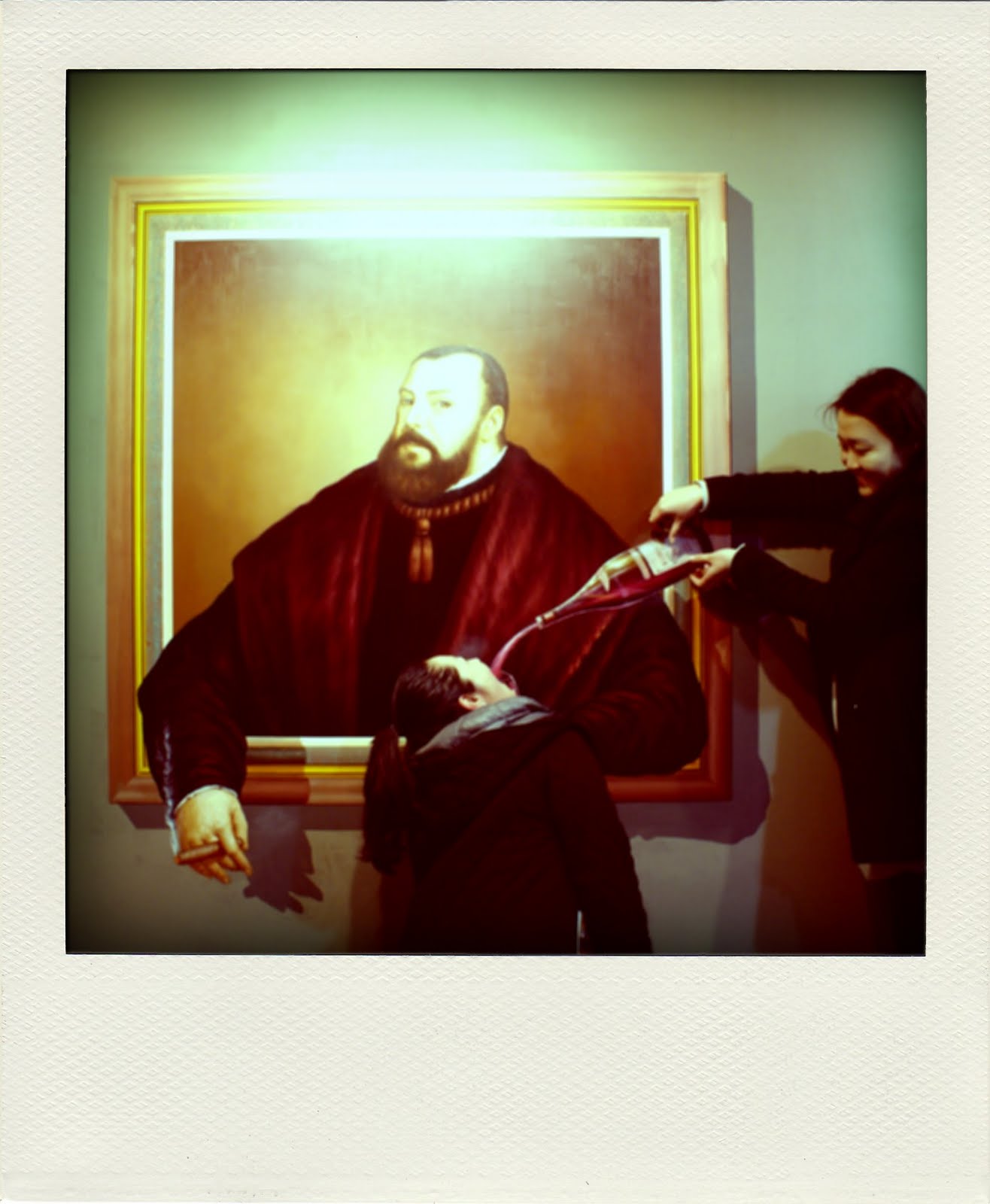
"Trick of the Eye" Trompeloeil Museum

Cyndi and I met up with Heng this weekend and she took us to the "Trick Eye" Trompeloeil Museum in Hongdae (nearish Exit 9). It was a shame that I was dressed like a granny and hadn't brushed my hair because we took tons of photos! The Tromepleil Museum features paintings using trompe l'oeil, a technique in which 2D art is made to look 3D.

Optical illusions + Photo Op = a yupgi girl's dream come true.

If you ever wondered what sort of underwear the screaming creature is wearing in Edward Munch's painting or wanted to ddong chim a cherubic masterpiece, then this is the place for you.


They even have a couple of those holographic paintings featuring a woman in various states of dress. Look at it from one angle and she's dressed in 18th century garb. Step a few centimeters to the left, and she's in her knickers. Step a little more, oh, look at it that. She's nekkid.
This place is a safe zone for silliness and juvenility.

The Trompeloeil museum is located in the 서교프라자 (basement, second floor). It's part of "Santorini Seoul" which as far as I could tell, is a hodgepodge of various "art" exhibits including the cat art gallery, a large "Where's Willy (Waldo)?" poster, and an exhibit featuring ugly dresses covered in ribbons (or something like that. I didn't really get the "concept"). Your 10,000 won admissions fee to the Trompeloeil Museum gains you access to all of the featured exhibits in "Santorini Seoul." As you can probably guess by the name, "Santorini Seoul" is meant to look like Santorini, Greece, which means there are lots of blue doors and blue skies. Are you in Hongdae or on the set of Mama Mia? No one will be able to tell.


Admissions is 10,000 won. Tickets are 8,000 won if you come in a group of 20 or more, but please don't come in a group of 20. The place is not big enough. 20 people will only mean that you'll always get a wayward elbow in your photo.

Hold onto your tickets, because admissions is 2,000 won less for each successive return. E.g., 2nd re-entry = 8,000 won, 3rd re-entry = 6,000 won, and so forth.

Hours of Operation
: 10 Am to 10 PM (must buy your tickets by 9 PM)
Phone: 02.3144.6300
For for more information about the museum, check out their website
http://www.trickeye.co.kr/

There's also a Trompeloeil Museum in Jejudo. They're aiming to expand the Jeju location to a massive Santoriniesque complex, at least that's what they've envisioned in their playdough model (you can see this model at the Hongdae location).

Side note: I think it's fascinating how Korean museum owners are weirdly focused on seemingly unrelated interests. The Trompeloeil people for example are into optical illusions, Santorini, and colorful paintings of cats. You got the butterfly museums in Jeju and Paju City featuring some rich guy's obsession with making "art" out of dead, expensive butterflies. You can't forget the Teddy Bear Museum and their creepy re-enactments of random moments in history/pop culture. Don't even get me started on the Jeju Sex Museum (which if you're curious is a cross between a College Campus Health Center and an otaku's hoard of Japanese hentai and figurines.)

Moving on... time for some photos! Keep in mind: Heng, Cyndi, and I are 3D. Everything else is 2D!


헹언니, 고마워요!

28 September 2010

Taking the GRE in Seoul - UPDATED

I am taking the GRE in October. I was already irritated by the fact that graduate programs even require such hogwash, but the whole registration process has got me resenting the whole ETS institution. I spit on you, ETS!* May you be afflicted with the itch, and have no nails to scratch with.**

I'm ever so grateful that I can take the GRE in Seoul, but can I just ask, how do all those ESL GRE test takers manage to register for the test? I, for one, found the process a bit mind boggling. It hurts my head just thinking about it.

It's very likely that I'm just a big moron, but I'm sure that there are other people out there who have had/will have a difficult time registering for the GRE in South Korea. Thus, I've decided to put together some tips and info. You are very welcome.


First of all, forget registering online. Thanks to bunch of dastardly, cheating fiends, test-takers in China, Hong Kong, and South Korea must take the Split-Test. This I have no problem with because (a) I got to do the Writing Section on the computer (b) I get to complete the Verbal/Qualitative using good ol' paper and pencil (c) I have a nice long break between the Writing and Multiple Choice sections.

People say that the new-fangled test, all done on a fancy little machine called the "computer", is preferable because the questions are adjusted as you go along. I for one, will sacrifice adjustments in exchange for the ability to underline and cross out words on paper.

I digress. Back to helpful tips...

STEP 1: Register for the Split-Test.

In order to register for the Split-Test you must register through the Prometric Regional Registration Center. Allegedly, you can register online, but when I clicked on the provided link for the Korean center, I got some error message about the site being hacked. I highly recommend that you simply call up the Korean Prometric office.


Prometric Regional Registration Center
Registration Phone:1566-0990
(Mon-Fri 9:00 AM - 5:30 PM)
E-mail: rrc@egios.com

The Prometric folks will send you an email asking you to provide your info: name, address, DOB, etc. After they've received your info, they will call you to confirm and ask for your payment information. (I provided my credit card information over the phone).

For some reason, I was hesitant to provide all of this info over email/phone, but there was just no getting around this process.

STEP 2: Complete the Analytical Writing Section.
If you are in Seoul, you must complete the Writing Section (aka the computer part of the Split-Test) at the Fulbright Building in Mapo-gu.

Fulbright Building, 168-15 Yomni-dong,
Mapo-gu,
Seoul NONE 121-874
KOREA, REPUBLIC OF
Phone: 82 2 3211 1233

Prometric provided me with the following directions to the Fulbright Building.

"DRIVING DIRECTIONS
1.TAKE OFF -SUBWAY 5 LINE GONGDEOK STATION 2.EXIT 1 3.LOOK FOR NATIONAL HEALTH INSURANCE B/D 4.FULBRIGHT B/D JUST NEXT TO NATIONAL HEALTH INSURANCE B/D."

At first glance, the directions seemed helpful. That is, until I got to number three, "Look for National Health Insurance Building." Firstly, you will not be able to spot the National Health Insurance Building from Gongdeok Station Exit 1. Secondly, even if you could fly or see through buildings, you would not recognize the National Health Insurance Building because its name will be written in Hangul.
There's probably a more efficient route (like this one), but here's how I managed to find the Fulbright Building.

3. Once you head out of Exit 1, follow the signs pointing towards the Seoul Digital University. I never found the Seoul Digital University, but I did find that the signs pointed me in towards the direction of my destination. You will find yourself walking past a large construction area (This will likely be a Tom 'n' Toms or a Paris Baguette by the time you read this) for about 7 minutes until you find yourself on the main road. I veered right and walked up this main road. If you spot ZuZu Bar (across the street), you know you're headed in the right direction.

4. Look out for a large building (there will be a guard stand out front) called 국민건강보험 (aka "National Health Insurance). Don't get too excited though. Remember, you are actually looking for the Fulbright Building.
5. Fortunately, the Fulbright Building really is next door, only the building is small, so it's easy to miss. Look out for a small alleyway immediately following the National Health Insurance Building.

Head up to the 2nd Floor of the building. Look at the posting on the bulletin board for instructions (in English) on how to proceed.

I ended up arriving at the Test Center more than a hour before my schedule time, but the Test Room Administrator let me go ahead and take the test early. It was quite nice to work in an empty room.
You are not allowed to take anything into the computer room, including a watch or a jacket.
The administrator will provide you with scratch paper and two pencils.
STEP 3: The Multiple Choice Section
I have yet to take the verbal/quantitative sections (the paper part of the test). The website simply states that the Seoul location for this part of the test is at Duksung Women's University.
Duksung University has a couple of locations, but after calling Prometric, I confirmed that the test will be at the Anguk location near Unhyun Palace. Thankfully, I know where this is.
Take the orange line (line 3) to Anguk. Take exit 4. Walk straight ahead for about 3 minutes (you'll pass Unhyun Palace). Turn left at the large entrance to Unhyun Elementary School.
Once you go through the entrance gates, follow the path until you reach a fork in the road. You want to take the path veering right. Follow this path until you see two light green telephone booths. I was told that the room number for the test will be posted on the glass doors.
*Updated:
- Room assignments will be posted on the bulletin boards just outside the entrance to the building.
- Make sure you bring your own watch. Your classroom may or may not have a clock. The test admin in my room moved the clock (originally positioned at the back of the classroom) onto the rail beneath the chalkboard. Unfortunately, my view of the clock was obscured by the tall test-taker in front of me. Fortunately, I had my own watch.
- Please be on time (if not early). It was so annoying (and a bit nerve-racking) to have to sit 30 minutes past the scheduled start time due to unapologetic late-comers. If you are bad with directions, allot yourself time to get lost. If you have a tendency to oversleep, set 4 alarms or get someone to wake you up. Please be considerate of others!
- Lastly, now that the GREs and grad school apps are far behind me, I can safely, and somewhat confidently say that the GREs are not as big of a deal as we are made to feel. I did fairly well on the reading,but average on the quantitative, and not as well as I should have on the writing section. The test doesn't say much in terms of what we have to offer as students, but in my estimation, merely reassures grad schools that we aren't imbeciles.
Not sure if this is at all comforting, but you can rest assured that personal statements, transcripts, resume, and recommendations are far more important. :)
So if it's a choice between cramming your brain with arcane vocab or reading books/papers relevant to your research interests, do the latter. This is what I did, and I got into all the programs I applied to. ***


*I really hope that I do well. Please do not invalidate my test scores.
**More curses here.
*** Pardon me. I don't mean to sound like a self-satisfied know-it-all.

05 August 2010

"You Son of a Beach"- A Tutorial on Swearing in English

I can't tell if this guy is being ironic. In any case, I learned some new Korean words. My mom will be proud.


Found this link via kottke.org

23 February 2010

Kangnam 25 Years Ago!

My family has told me that not too long ago Kangnam was nothing but farmland. Having worked in Daechi-dong for a while, it was hard for me to imagine Kangnam pre-hagwons and Pascucci. Today Cousin N showed me some photos featured on Yahoo Korea -- photos of Kangnam in the early eighties. Wo! If you had me guess the date of the photos, I would have guessed that they were taken fifty years ago.

Now I realize why my mother was so overwhelmed when she came to Seoul last year. It's easy to overlook how drastically Seoul has changed in the past twenty-five years. Looking at these photos I realize that Seoul is like the Heidi Montag of world capitals.


1983 Songpa-gu, Oryun-dong, Location of Olympic Park & the Park Hotel now stand.


1981 Songpa-gu, Bangi-dong


1983 Daechi-dong, in front of Eunmaa Apartment

30 July 2009

My Dongsaeng the Gisaeng

My dongsaeng, Doogal and her NP were looking to get a couple's portrait while they were visiting in Seoul last month. While strolling through Insadong we stumbled upon the Hwang Jiny Photo Cafe. I'm not sure why it's called a cafe when they don't serve coffee, but it turned out to be a great a place to dress up in Korean costume and get your photo on.

Photo packages vary in price, but my sister opted for the basic couple package at 100,000 won. The package includes one costume selection for each person, make-up, two print-outs (which are photo-shopped by the photographer), and a CD containing all of the photos from the session.

The cafe offers a variety of traditional hanboks as well as more costume-y hanboks, like the ones featured in TV dramas. My sister opted for the brightly hued look of a gisaeng, who were, for lack of a better definition, the geisha of old Korea.

*If you bring in the brochure (available at the front of the building), you get 10% off.


Check out the video to check out all the fun. My sister had a great time, I'm almost tempted to go back for myself. Though, I don't think I need more awkward pictures of me in heavy makeup and crazy hair.

My Dongsaeng the Gisaeng from Annalog on Vimeo.


Now, time for a quick "Who Wore It Best?"


The wig looks so crazy without the hanbok.

09 July 2009

Korea, NO. KoreaN, YES.

My cousin, VP told me about this recent public service announcement produced by Kobaco. Essentially, the PSA encourages "Korea" to be warmer and more thoughtful -- to be "KoreaN." I'm guessing that the 'n' in KoreaN stands for "New Korea."

This PSA is pretty awesome. It captures a number of my gripes about living in Seoul. It's especially heartening to see that the video was produced by a Korean organization.
Hopefully the message is better received. It's like when your mother tells you to lose weight. Only a mother can get away with calling you fat.

Anyhow, I wanted to share this video with y'all, so I asked Cyndi helped me to translate the video.

-------------------------------

KOREA [Scrolling shot of shiny skyscrapers that are allegedly in Seoul]
"We have changed, but..."
KOREAN [Shot of ajusshi yelling rabidly from his car. 짜증나!]
"We need to change more."

KOREA [Close-up of a woman using wi-fi to chat with her friend via webcam]
"We've advanced, but..."
KOREAN [The same woman is laughing loudly in the cafe, to the annoyance of the other patrons]
"We need to move further."

KOREA [Close up of a map, transitioning to a nice shot of Incheon airport]
"We've gotten closer, but..."
KOREAN [SHot of a Korean man rudely brushing past a foreign man on the escalator]
"We can get closer."

KOREA [Dynamic shot of sports fans cheering on Korea]
"Our hearts are warm, but..."
KOREAN [Shot of lonely foreign man waiting at a train stop]
"We have to be warmer."

"Korea 보다 더 자랑스러운 KoreaN."
Translation: KoreaN, prouder than Korea.


03 June 2009

What is Chejil?

I don't know if you're tired of hearing about my chejil, but I swear, it's kind of taken over my life.

So, y'all are probably wondering, what is this chejil (체질)? Here's what I've learned through my Cousin N, our hanuisa, and some cursory searches through Google. For a long while, according to findings in Oriental Medicine, humans were classified as one of four body "constitutions" or chejil. One's chejil is determined from birth and is distinguished by the relative size and strength of one's organs. In turn, one's chejil influences one's appearance, temperment, physiology, and pathology. A specially trained hauisa, is able to determine your chejil based on your pulse. source

In 1965, after extensive research and practice, a Korean Doctor of Oriental Medicine, Dr. Do Won Kwon, developed this concept of chejil further and found that humans may be classified as one of eight body types. source

Go ahead and search "8 Constitution Medicine" if you'd like the complete listing of the eight body types. I am only familiar with three.

Pretty much everyone at The Hagwon has gone to see the hanuisa - my cousins (the bosses), our office manager (kwajang-nim), and the other instructors. Funny enough, we all fall under one of three chejil: toyang (Pancreotonia), mogyang (Hepatonia) , or gu-um (Colonotonia).

Here's what I know about the three:

1. Toyang [토양]
The most common body type, according to the doctor, is toyang. Folks with the toyang chejil are advised to avoid fowl, spicy food (including mustard, green onions, and onions!), sesame oil, and nuts. Theoretically, this diet doesn't seem so bad, unless you live in Korea. The toyang chejil is apparently very common amongst Koreans. Good luck trying to get Koreans to cut out kimchi. Toyangs are known to be sweethearts, but they can also be impulsive and quick-tempered.

2. Mogyang [목양]
One's chejil is hereditary. Thus, based on the fact that all three of my co-workers/cousins are mogyangs, I've surmised that my mother is most likely a mogyang. Given that I'm surrounded by mogyangs, I learned a lot about this particular chejil. For example, typically, mogyangs are shaped like a snowman. (In English, we call such figures, pear-shaped, but I suppose that pears are round in Korea so such a term would refer to a different body shape.) Due to their weak lungs, mogyangs are told to avoid seafood and leafy vegetables. I would have thought that leafy greens are good for the lungs, but what do I know? It's also important for mogyangs to sweat. If they don't sweat, something is wrong with their body.

In terms of temperament, mogangs are known to be kind-hearted risk-takers who don't like to talk. In fact, excessive talking is bad for a mogyang's health.

Cyndi, Cousin N, and Cousin N's eldest daugter, J, have all been sticking quite faithfully to their mogyang diets for the past three weeks. They all seem to be enjoying their prescribed diets, though they're still waiting to see the results on their figures.

The doctor did note that if a person wants to lose weight, s/he must eat the same portion size for breakfast, lunch, and dinner. I would have interpreted that to mean a super-sized breakfast, super-sized lunch, and super-sized dinner, but it sounds like he was saying to limit one's portion size.

3. Geu-eum [금음]

This is my chejil. Wah. Wah. Wah.
I'm told that my chejil is not very common. Probably for good reason. I think a lot of people with my chejil must have died -- out of misery. As I've whined about before, geu-eum aren't allowed to eat meat, dairy, flour, root vegetables, coffee, sugar, soy beans, and a bunch of other things that I'm going to ignore. As the doctor explained to me, I'm like a cow. If a cow can't eat it, I can't eat it. I didn't realize that cows like seafood, but I'm sure glad that it's on my "good for me" list. Geum-eums are also supposed to avoid excessive use of the computer. In fact, continuing with this long rambling post might be quite detrimental to my health.

Cousin N. translated a few passages from the book she purchased at the hauiwon. According to this book, ge-eums are very intelligent (true dat), but also ambitious, potentially tyrannical, and well-suited for politics (Who determined this? I'm going to punch his lights out and burn down his village!) Geu-eums are thought to make great marathon runners. The first reason being, we have strong lungs. More importantly, however, when a geu-eum sees a person fall in the race, she will be energized and more motivated to charge on ahead. (For the record, that's so not true...I would never run a marathon.) Famous geu-eums include Picasso and Nero, ancient Roman tyrant. I didn't realize that both Picasso and Nero went to a hanuiwon.

I've been pretty darn faithful to my chejil diet for the past three weeks. Do I think it's worth the effort? I'll have to give you my response in another post. This post is already way too long. Plus, I have to go terrorize the downtrodden.

28 May 2009

체질

Seong, Cyndi, and I went back to see the hanuisa (Doctor of Oriental Medicine), and after a final screening, the doctor identified our respective 체질 (chejil).

I'm going to have to dedicate another post on this whole chejil concept, but here's the gist of it: all humans maybe be classified as one of eight body types. According to this holistic approach to medicine, one's physical constitution, and hence, diet, are tightly linked to one's personality, well-being, and physical health.

The doctor handed each of us a brief summary about our respective body types. I'm just going to let you all take a gander at our chejil for yourselves. I will fill you in on how the diets are affecting each of us and how we are coping in a whole 'nother post. Trust me. I have A LOT to say.

CYNDI's Chejil: 목양체질 (aka Hepatonia)


Things that are harmful to Cyndi:
All seafood, leafy greens, cucumber, egg plant, mung bean, cabbage, cocoa, chocolate, buckwheat flour, persimmon, Chinese quince, papaya, peaches, pineapples, cherries, green grapes, grape sugar/dextrose/glucose, dextrose injections, swimming, blue wallpaper, cigarettes, Vitamin E, amalgam.

Things that are good for Cyndi:
All types of meat, rice, soy beans, flour, coffee, milk, all root vegetables, garlic, pumpkin, mushroom, sugar, fresh water eel, mud fish, cat fish, carbonated drink, pears, apples, watermelon, nuts (walnuts, chestnuts, pine nuts), antlers of young deers, ginseng, Vitamins A, B, C, D, E, gold caps/filling, gold injections, aspirin, hiking, breathing exercises, reddish hues.

Basically, Cyndi should split her time between gogi BBQ places and the sauna.

ANNALOG'S Chejil: 근음체질 (aka Colonotonia)


Things that are harmful to me:
All types of meat, whale meat, garlic, deer antlers, fresh water fish, coffee, artificial flavorings, flour, pumpkin, soy beans, milk, sugar, adlay (wild grains), pears, apples, melons, chestnuts, pine nuts, ginko nuts, all root vegetables, mushrooms, taro, Vitamins A, C, D, E, aspirin, carbonated drinks, gold injections, atropine injections, hot baths, hiking, excessive use of computers and other electronic devices, residing in the forest, and penicillin.

Things that are good for me:
Buckwheat, rice, glucose/dextrose, all seafood, all leafy vegetables, bean sprouts, mung beans, cucumbers, bracken (a type of edible fern), seaweed, salted fish, grapes, peaches, persimmons, cherries, pineapples, strawberries, green onion, mustard, ginger, pepper, cocoa, chocolate, swimming, breathing exercises where I inhale quickly and exhale slowly, yellow hues.


Basically, I should hope that I never need medical care from a hospital, and I should move to Japan (and avoid forests).

16 May 2009

Is a life without cheese a life worth living?

Cousin N told us about this great 한의사 (hanuisa), Doctor of Oriental Medicine, she saw at 새시대 한의원의 in Sinsa-dong (Kangnam). Basically, the doctor is able to determine what sort of diet is best for your body type and personality. I don't know very much about oriental medicine, but when I heard that Cousin N was instructed by the doctor to restrict her diet to meat, carbs, and root vegetables (all things my cousin had been avoiding), my interest was totally piqued. Also, I've had digestive problems in the past and suspect that my diet is a big factor in my skin issues, so I was particulary curious to hear what the doctor would say.

Thus, Seong, Cyndi (Yup. She's ba-ack!), and I headed over to the clinic for an exam. Cousin N had told us that the clinic is pretty famous. From the looks of the packed waiting room, the doctors there must be doing something right. Our appointment was at 10:00 AM, but we weren't seen until an hour later!

First, the receptionist will have you fill out a questionnaire about your eating habits, digestion, and other relevant information. (The questionnaire is all in Hangul). Next, they'll strap your right pointer finger to a device that measures...something. I'm not sure what. Electromagnewhatchamacalits? Then, they'll take your blood pressure.

Once you get to see the doctor, he'll have you lie down on the chair (Don't worry. There's no funny business), and ask you what ails you. Then, with two fingers, he'll measure the pulse(?) at each of your wrists. Lastly, he'll apply chim (acupuncture) to your legs and arm. After all that, he'll make some notes on his chart and tell you what you can or cannot eat.

Seong went first, and her examine seemed quite brief. After measuring the pulse(?) at each wrists, he pricked her right leg and arm. Then, he announced that the foods she should NOT eat. He mentioned a few items, including spicy food and chicken! Man, that sucks. How do you live in Korea and aovid spicy food and chicken. (I know. It's possible, but not preferable).

When it was Cyndi's turn, the doctor also examined her pulses(?), but this time, he applied the needles to her left leg. The doctor's instructions to Cyndi were quite simple. Absolutely do NOT eat seafood and leafy, green vegetables. I think Cyndi was relieved that soju and gogi weren't on the restricted list.

Last but not least, it was my turn. I think the doctor may have taken twice as long to examine me. Firstly, when he measured my pulses(?) he kept going back and forth to each arm, with a focused expression on his face. Then, when it was time for the needles, he pricked both legs, both arms, AND my fingers. When I had asked Seong & Cyndi if the needles hurt, they had said that it was just slightly more uncomfortable than a tickle. I'm not sure what kind of needles the doctor used on them, but the needles he used on me hurt! Either I'm huge wimp or I'm really unhealthy. Either way, it wasn't a good sign.

Then it came time for his diagnosis. Here's is how the conversation (translated into English, with some assistance from Seong and Cyndi) esentially went.

Doctor: You're [you're diet] is kind of...picky.

Anna: (inward groan)

Doctor: You may not eat flour.

Anna: (Loud gasp)

Doctor: You may NOT eat meat. ANY kind of meat.

Anna: (I flail myself onto the chair and moan in despair.) Can you ask him if SPAM counts as meat?

CYNDI: He says you can't eat SPAM.

Anna: ...

Doctor: You may eat egg whites, but you can't eat egg yolks.

Anna: Ahhhhhh! (What am I supposed to eat for breakfast?)

Doctor: You can't eat any dairy products.

Anna: You mean cheese and yogurt too? @!#$%!

Doctor: You may not eat root vegetables.

Anna: No problem --- Wait! You mean I can't eat kkakdugi and mu!!!!!!!! What about potatoes?

Doctor: You should eat potato in moderation.

Anna: :(

Doctor: You must also avoid all fried foods.

Anna: Waaaaaaaaaaah!!!!!!!!

Doctor: If you use oil, stick with olive oil.

Anna: (Slumped over the chair in defeat)

So, let's recap. 1) I can be a bit melodramatic. 2) According to the doctor, for the next week or so, I should stick to eating seafood, vegetables, and rice, and basically avoid all other food groups.

This is not going to be easy, people.
I know what you're thinking. Why are you listening to the doctor?
The answer is: because I'm curious.

I've never thought about what I ate, and have never restricted myself when it comes to food. I see this as an interesting challenge.

Also, the doctor just wants us to try our assigned diet for the next week, then come back and see him for a follow-up. This is when he will re-examine us, as well as get our feedback on how we feel.

I'm determined to stick to this diet out for a week, and see what happens. So far, I've been good. I had seafood pho for lunch and fish and rice for dinner. One of the mother's even bought us cupcakes for teacher's day, but I resisted! I'm so impressed with myself.

If you're interested in checking out this clinic for yourself, here are the deets. (Please note that you need to speak Korean or go with someone who speaks Korean.)

Saesidae Oriental Medicine Clinic
ANC Building (4th Floor)
Get off at the Sinsa bus stop.
The building is located between Kia Motors and Woori Bank.

07 November 2008

Hey, there, Fattie! Did you finally lose some weight?

The other day, I saw a friend who I have not seen for awhile, and one of the first thoughts that popped into my head was, "You've lost weight!" Thankfully, I managed to catch myself before uttering this out loud.

First of all, my friend did not need to lose any weight, so for me to exclaim "You've lost weight" in a complimentary tone would be silly. Secondly, I haven't seen my dear friend in over a year, and the first thing that pops into my head is a comment about her weight!?!

That's so ajumma.

I don't recall ever being so weight-conscious. I hesitate to pinpoint my year in the Motherland as the source of my subconscious weight-hatin'. After all, we are so weight-conscious in America that even rich folks willingly go without food. On the other hand, unless you're a host on some American style-makeover show or just a plain ol' jerk, you rarely say something about a person's chunkiness -- to his or her FACE.

For the past couple of years my weight has fluctuated by a small margin. Nonetheless, whenever I go home to see my family, someone will comment on my weight. One person will say that I've lost weight, while the next person will exclaim that I've gained weight. I never know how to reply to such remarks. I certainly can't thank the person for keeping tabs on my weight. I usually just reply with an awkward shrug and say, "No, I weigh pretty much the same as when I last saw you."

I've decided to stick with this response for the rest of my life. Even after I've gained 40 pounds of post-baby weight, I'm just going to say, "Really? My weight's still about the same."

I'm not really bothered by comments on my weight, but rather, am disturbed by the hyper-awareness exhibited by my family members, as well as people in the Motherland, all in the name of appearance. At the same time, I honestly don't think they mean to be hurtful when they say something about a person's weight.

Let's rationalize.

I think Korean weight-hate can be attributed to projection. The person is so concerned about their weight that they assume you are too. Most of the weight-hatin' comes from Korean ajummas, after all, who were probably very petite and slim in their youth, and thus, have difficulty accepting plus-size status in their middle years.

I also think there's a significant difference between Korean small-talk and American small-talk. In America, you're more likely to ask something innocuous like "Ooh, did you cut your hair?" or "Did you see that new Mark Wahlberg movie?" No harm, no foul. In contrast, Koreans, perhaps due to a greater sense of oneness, do not hesitate to ask something more personal like, "Did you gain weight?" or "What happened to your skin? Why do you have so many pimples?"

I'm sure that some people take a little pleasure in pointing out seeming flaws, but I think that for the most part,when a Korean says something critical about your appearance, I think he or she actually thinks s/he's helping you...? It's as if they mean to say, "In case no one's told you, your butt has grown at least five meters since I last saw you." It's like telling someone that his fly is down or her skirt is tucked in her pantyhose...I guess.

I have to also add, though Koreans are quick to comment on your extra blubber or the pockmarks on your face, they're also just as quick to compliment you or revel in your uncanny resemblance to some celebrity that's in actuality way hotter than you.

It's sort of like how your mother still unfailingly believes that you could be the future president of the U.S.A, but at the same time, is the first person to point out (and herald) your laziness or any of your other many flaws. They hurt you only because they care (and can).

I guess the whole point of today's ramble is that I'm am slowly turning into an ajumma. The transformation is inevitable...

04 October 2008

You can take the girl out of the Motherland, but can you take the Motherland out of the girl?

In movies and books, the protagonist often comes back from a year abroad having experienced some great change or epiphany. I'm more of a gradual change type of person, so I can't say that I came back from the Motherland transformed in some fundamental way (other than some eyelash extensions and a cheap dress addiction). On the other hand, after a few days in the Homeland, I've noticed that I picked up a few new habits and preferences from my time in the Motherland.

Okay, people. Sit back and relax. It's time for another list.


10 Signs That You've Just Returned from a Year in the Motherland (aka South Korea)
(in no particular order because I don't like to rank things)

1. Immediately after finishing your meal, you walk up to the cash register and demand the check only to have a perplexed hostess say to you, "Please have a seat. Your server will bring you your check."

2. You forget to tip your waitress.
"Oh, right. 15%. What? 20%? That's outrageous! Service is my divine right!"

3. You openly examine yourself in reflective surfaces without any hint of sheepishness or irony.

4. You wear heels to do un-glamorous tasks like walking the dog or buying detergent at Target.

5. You eat samgyupsal without any rice.
You don't have the "meal" or shiksa until after you've had your fill of grilled gogi.

6. You go out in public even though your face is a shade lighter than your shoulders.
(In my defense, I'm not purposely trying to look "whiter." I'm just trying to cover up my blemishes with some b.b. cream!)

7. You crave a steaming hot tang or jigae on a blistering summer day.

8. You take pictures of yourself.
Eww. Not those kinds; ones of you acting cute or silly, usually with the camera angled above your head.

9. You automatically bow with every greeting or thank you, as if you were some Geisha robot.

10. Social gatherings never end with one round.
You need to at least hang out until sam-cha, "round three." Typically, 1-cha is dinner. 2-cha involves soju. 3-cha is the time to sober up at the noraebang. If your night carries onto the 4-cha or 5-cha, you'll need to make sure you have the number for a cab or daeri-oonjun.

I'm really glad that I didn't drive in Seoul. I can only imagine the gnarly driving habits I'd have learned. Running red lights and stop signs, u-turning wherever I pleased, swerving into lanes like a convict on the run -- I'd be an accident waiting to happen.

21 September 2008

Koreality TV

I usually stick to Onstyle, Fox Life, CGV, or OCN when watching TV in Korea. Other than the music shows and a few dramas, Korean shows have always been a little too "busy" for my tastes. After watching the third season of Project Runway for the umpteenth time, I have become more interested in a few variety programs. In case, you were interesting in watching more Korean TV, here are a few of my picks.


무한도전
Infinity Challenge
MBC/Sat 6:35 PM
This one is a classic, starring some of those most popular male MCs in Korea, including my MC crush, Yoo Jae Suk. Each episode, the cast is given a special mission where hilarity inevitably ensues. Past missions include sportscasting live matches at the 2008 Beijing Olympics; a traditional Korean meal with Paris Hilton; and more recently, preparing for Chuseok dressed in drag. (I really wanted to see that episode). I think this is one of those shows you can enjoy without knowing a lot of Korean. Their exaggerated expressions and reactions are universally goofy.


미녀들의수다
Global Beauty Talk Show
KBS / Mon 11:05 PM

If you are a young foreign woman who speaks at least a smidgen of Korean, you've probably had a Korean person say, "You should audition for Misuda!" I used to watch this show back at home with Cyndi's mom (Thanks, youtube!), but haven't been watching the program as often now that I'm actually living in Korea. This show features young foreign women from around the globe (okay, mostly Asia) who share their experiences and thoughts about life in Korea. The show seems to be running out of original topics, but when it first began, the show offered interesting insight into the perspective of foreigners (the non-laborer types) in Korea. Most of the panelists are not ethnically Korean, so their level of Korean is quite impressive -- definitely better than mine.


춤추는 용형동제
Dancing Yong and Dong
Mnet/ Fri 6:00 PM

I've only seen a couple of episodes, but watching Shin Dong do the U-Go Girl dance cracks me up to no end. During each episode, Jung Jae Yong (from DJ DOC) and Shin Dong (from Super Junior) are assigned to learn a dance from a popular music video. After tutorials from professional dancers, they are ambushed throughout the week with pop dance quizzes where they are then forced to perform an excerpt of the dance. It doesn't matter if they're having dinner or getting their hair done at the miyongshil, they must dance. I can't recall the consequences for failing the test, but I think it's some form of shame. At the end of the episode, Jung Jae Yong and Shin Dong must perform the entire routine (in costume). I think they're allotted up to three mistakes -- collectively.


우리 결혼했어요♥
We Got Married
MBC/ Sunday Night

At first my emo-bu couldn't understand my mom & emo for staying up late to watch this show, until one night, he watched a full episode, and then he was like "I see." The premise sounds lame at first, but stick with me. Popular celebrities are paired up by the producers and assigned to live as a married couple. This show is what VH1 would probably label as "Celebreality." The marriage and scenarios are completely staged by producers, but the show is driven by the personalities and chemistry of the celeb participants. Each couple represents a marriage archetype. Every WGM fan has their favorite couple (or spouse). I think that a person's favorite is very telling about an individual. My mom, for example, likes Crown J. A! He's showy, but sweet. I guess my mom is more of Seo In Young type of gal. My emo, on the other hand, likes Alex. I'm a big fan of Alex the singer, but Alex the husband is too romantic. He's really big on "events." I can't say that I'm a fan of anyone in particular, but if I had to pick, I'd go with Kim Hyun Joong from Double-S501. I am by no means into those so-called "idol" groups, but I do like the fact that he is goofy and weird, though a little dim. He also reminds me of a Japanese actor that I like.


패밀리가떴다
Family Outing
SBS/ Sunday Night

This one's a current favorite. Each week, the celebrities, acting as family, take an overnight trip to the countryside, somewhere outside of Seoul. The producers send the current residents (usually a halmuni and harabuji) to spend a relaxing night in the city, while the "family" takes over. During their stay, the cast plays games, does chores, cooks for themselves, and torments each other -- just like a real family. The show seems to be growing in popularity thanks to the excellent chemistry between cast members. Off course, my crush, Yoo Jae Suk acts as the family patriarch. His interactions with Daesung (boybander from Big Bang), Lee Hyori (formerly of FINKL), and Lee Chun Hee (actor) are especially fun to watch. After watching the show, I also realize why Hyori is such a big deal. She's really quite personable and funny.


세상에이런일이

SBS Thurs 8:50 PM
Wow! How?
I haven't really been watching this series since moving to Korea, but my mom is a big fan. This show features segments of curious (Oh! Wow!) events, things, and people from around the world (Okay, mostly Asia). For example, I once saw a segment about a girl in China who eats chunks of dirt -- by choice. She cooked dinner for her family, and then took out a side of dirt for herself. Wow! I also recall a segment on a Korean man who eats crab shells and bones, as if they didn't have the potential to hurt his jaw. The show had the man consult with a dentist, and his teeth appeared perfectly normal.

Sorry. Couldn't find a clip.

18 September 2008

Pigs...Not Just Good for Samgyupsal


I'm sorry if you found the picture disturbing, but in Korea, a pig with cash sticking out of its nose is no big deal. More on that in a little bit...

THE HAGWON, newly founded by one my many cousins, has gone under way. Despite all the bureaucratic hoops we had to jump through, we're finally open for business! I've taken the lead on developing the curriculum, which has proven to be demanding, but fun. THE HAWGON is not quite a month old, but if its burgeoning popularity is any indication, I think we have a bright future. Knock on wood. Or should I say, "Help us, Mr. Pig..."

During the opening reception, one of my cousin's friends prepared an old Korean shamanistic ritual. You can read more on the significance of pigs at the Seoul Metropolitan Government website, but basically, Koreans traditionally see pigs as a sign of wealth and prosperity. Thus, it is a common practice for folks to put out a pig's head at the start of a new business or big deal endeavor. The pig's head is placed upon pans of ddeok (the one with lots of whole beans) surrounded by candles and makgeoli. Guests then bow and place money in the pig's mouth (I stuck my bill in his nostrils) as a sign of best wishes. In return, guests and neighbors are given a portion of the ddeok, which I hear, goes very well with kimchi.

My cousin told me that contractors usually conduct this ritual after they've put up a building and will use the money to buy some well-deserved beer for the construction workers. We, however, did not buy beer. The money was prudently used for office appliances.

Prior to the reception, an unmarked cardboard box had been delivered to the hagwon. I unwittingly opened the box thinking it was another box of ddeok. Can you imagine my fright when I lifted up the flaps and found the Lord of the Flies!?!

I like bacon as much as the next Korean girl, but I do not want to see its face. :)

Call me biased, but I think THE HAGWON is special. I hope others will feel this way as well.

May the pork be with us.

14 September 2008

Making Songpyun: The fate of your children is in your hands

The streets are eerily free of rampaging pedestrians and young women teetering in their high heels. There's a curious hum in the air, uninterrupted by the sound of blaring horns. Where have all the cars and people gone? Mass alien abduction? Nope. It's Chuseok time!

Most of the Seoul Patrol has headed out of town to spend quality time with their family (both the dead and living), so the city feels relative empty. Me likes it.

I can't believe I'm celebrating my second Chuseok in the Motherland. Last year, we went to down to Busan to fry fish with Cyndi's relatives. This year, since my mom is still in town, we're spending Chuseok in Seoul. I have to admit, Seoul sans half its population is quite pleasant. As my mom would put it, it's a little less jeongshin eopso. I feel like I have more room to breathe and think.

My cousin Nani invited us over to her house to make songpyun, traditional rice cakes shaped like half-moons. It is a Chuseok tradition for the women of the family to sit around and gab while making songpyun. My family of course is always big on the gabbing and gossip, but we usually buy the songpyun from a store. Fortunately, Nani is quite knowledgeable about Korean traditions and was able to school us on some Motherland culture.

In honor of Chuseok, my family and I offer you a simple tutorial on how to make songypun.


THE "DOUGH"
In order to make the "dough" (not sure of the correct term), take soaked uncooked rice (쌀) to the rice mill professionals (방앗간) and have them process the rice with salt, producing a sticky rice dough.

In order to add color to your dough, you made add one of the following ingredients:
omi tea (오미자차) = pink
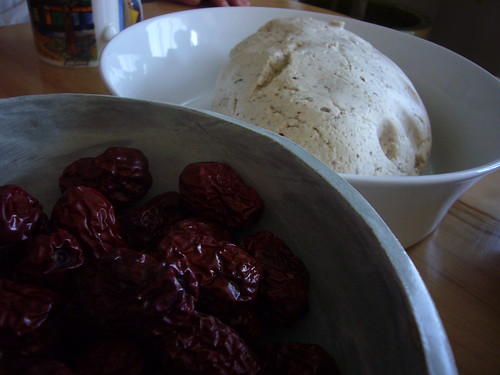
jujube (대추) = brownish
mugwort (쑥) or spinach (시금치)= green
By no means, should you use artificial coloring for your songpyun. Nani told me that it is strongly frowned upon in traditional Korean food culture. You can dye your hair, but don't mess with your ddeok.


This is what the "dough" looks like with no additional ingredients.


This is what the "dough" looks like with ground jujube.


THE FILLING
As a product of harvest celebrations, songpyun are filled with beans, chestnuts, or sesame seed pastes. We had three different options:
- chestnuts (밤) mixed with sugar
- sesame seeds (깨) mixed with brown sugar and honey
- sliced jujube (대추) - not pictured


ASSEMBLY

Please view the video for a demonstration of how to assemble the ingredients.


According to my mom, your ability to make "pretty" songpyun foretells the prettiness of your children (she also says this about making mandoo). My mom claims that she was told that her songpyun were very pretty. Following suit, this means that my sister and I are "neomu yebbeo (so hot, hot)" all thanks to my mom's mad skills. I don't care what you haters think. The songpyun never lie.

Based on the sorry songpyun that I made today, let's just pray that my future children have sparkling personalities.

Nani also told me that the songpyun are half-moon shaped, rather than completely round because the shape suggests that you still have something to fulfill (or to accomplish), while a complete circle suggests that your life is complete; meaning there's nothing left to be done. It's all over. At least, that's what I think she said.

It'd definitely be much easier to roll the dough into a little ball, but I appreciate the significance of the half-moon shape. It's a shame, though that my ineptitude for making pretty half moons will mar the beauty of my future offspring. Mama's really sorry, future kids.

STEAMING
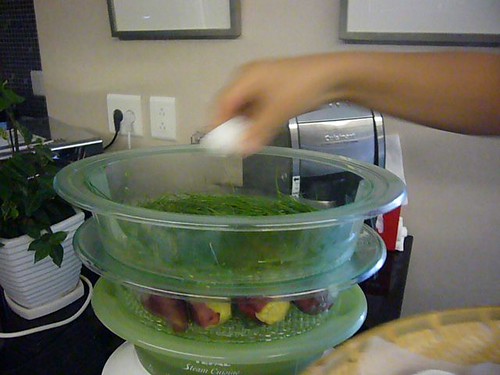
Steam your beautiful little half-moons upon a bed of pine needles. The pine's purpose is two-fold. 1) It keeps the songpyun from sticking to the pot. 2) The pine needles infuse themselves in the songpyun, making the ddeok much more tasty and fragrant.


After steaming the songpyun for about 15 minutes or so (no sure about the timing) rinse the ddeok in a bowl of sesame oil, or if your calorie conscious, a mixture of sesame oil and water. The sesame oil will leave your little ddeok babies glistening just like the ones made by the professionals.

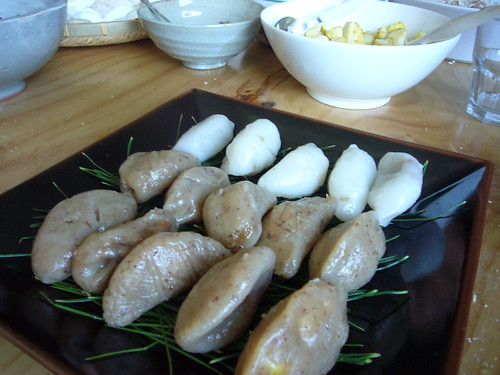
TA DA! THE FINAL PRODUCT


Okay, I know that they're not much to look at, but I think we did a pretty good job. We all especially liked the sesame filled songpyun because unlike those stingy professional songpyun makers, our ddeok was bursting with the sweet, honey paste.

Chuseok is the time to pay respect to your ancestors, hang with your family, and give thanks for the bounty of this year's harvest. I hope you take the time to do this, wherever you may be.

Special thanks to my family (Umma, Emi, Emi's BFF, Nani, and Vice President) for letting me blog and post pictures about our songpyun workshop.

즐거운 추석!